

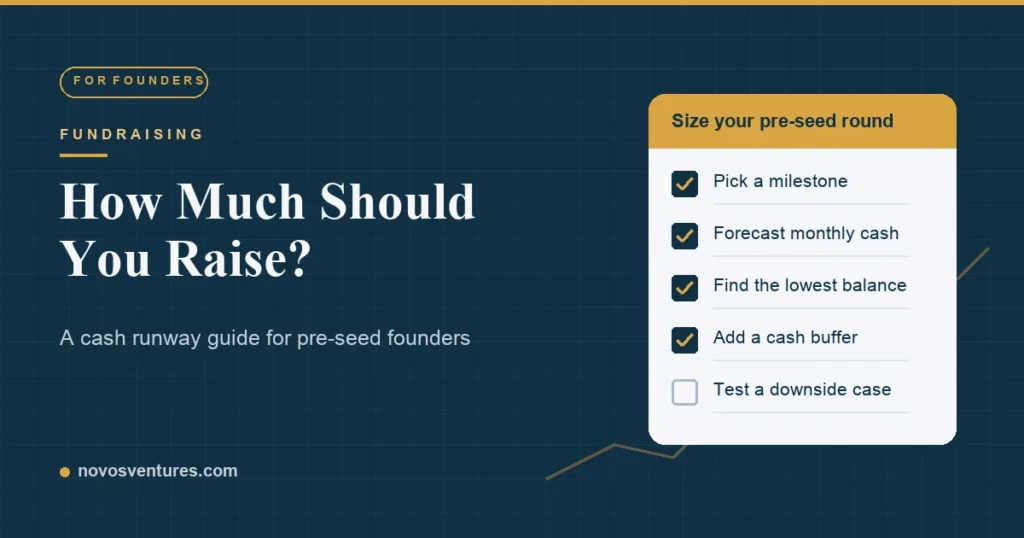
A fundraising target should answer two questions: what will this round let you prove, and how much cash will you need to get there? If you’re preparing a pre-seed round, start with the milestone and build a monthly cash plan around it.
1. Pick the milestone the round will fund
Write one sentence describing what you expect to have achieved by the end of the round. For a B2B startup, that could be launching the product and converting three paid pilots into annual contracts. Then put dates and costs against the work required: product delivery, hiring, customer acquisition, and any compliance or onboarding work.
2. Forecast cash month by month
Start with cash available today. For each month, add expected cash receipts and subtract payments. Put customer receipts in the month you expect the money to arrive, which may be later than the invoice date. Include one-off costs and model the date when investment proceeds would actually reach the bank.
A quick runway estimate is current cash divided by average monthly net burn. If you have €90,000 and spend €20,000 more than you collect each month, that’s about 4.5 months. The monthly forecast gives you a better picture when a hire, a late payment, or a large bill changes the pattern.
3. Size the round around the cash low point
Suppose your base case shows a planned cash draw of €450,000 over 18 months, with the lowest balance in month 18. You have €90,000 available today and want a €60,000 cash buffer. The illustrative funding gap is €420,000 (€450,000 less €90,000 plus €60,000). If delayed sales increase the cash draw to €540,000, the same calculation gives €510,000.
Check the months before a likely close separately. If the balance hits zero in month four and you expect the round to close in month five, the eventual round size won’t solve that gap. Bring forward collections, phase spending, or model the cost and timing of bridge funding. Keep uncommitted fundraising proceeds visible as a separate assumption.
4. Make the ask easy to explain
Put four items on the fundraising slide: the amount, the milestone, the main uses of funds, and the runway under your base case. Keep the downside case and the assumptions behind it in the model for follow-up questions. Use the same numbers in your pitch deck and cash forecast.
Enterprise Ireland’s startup support page outlines available programmes and the business materials founders may be asked to share. To develop your own fundraising model and pitch, explore Novos Ventures’ Investor Readiness service or read our guide to structuring a pitch deck.
Further reading: Enterprise Ireland startup supports.
Work out your own numbers
Open the full calculator, worked examples and FAQ
Funding news and practical founder guides. Free.
Illustrative only. Not financial or legal advice. Nothing you enter leaves your browser.