

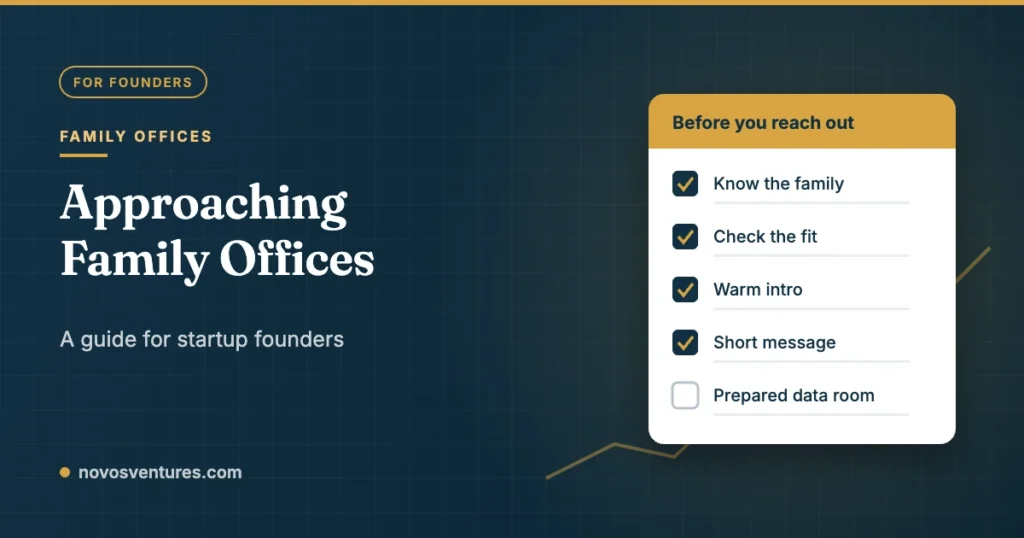
Family offices are one of the least understood sources of startup capital. Many founders spend months pitching venture capital funds and angel networks without realising that private wealth, managed directly on behalf of a family, can be a patient and well-connected investor in early-stage companies. Others hear about family offices, send a deck to a generic inbox and never hear back.
This guide explains what family offices are, how they differ from VCs and angels, what they tend to look for, and how founders in Ireland and the UK can find and approach the right ones. It is practical guidance, not financial or legal advice.
What is a family office?
A family office is a private organisation set up to manage the wealth, investments and often the wider affairs of a family. A single-family office serves one family; a multi-family office serves several, sharing staff and infrastructure. Some are large, with dedicated investment teams. Many are small: a handful of people, with the family itself closely involved in decisions.
Most family offices invest across property, listed markets, private funds and direct holdings. Direct investment in private companies, including startups, is usually only one part of the portfolio. That matters: you are not pitching a fund whose only job is to back startups, but a team deciding whether your company deserves a place alongside everything else they own.
How family offices differ from VCs and angels
It helps to understand the incentives behind each type of investor.
- Venture capital funds invest money raised from limited partners, within a fixed fund life. They need a small number of very large outcomes, so they look for companies that could return the whole fund.
- Angel investors invest their own money, usually in smaller cheques, and often back founders they know or sectors they have worked in.
- Family offices also invest their own capital, but often in larger amounts than individual angels and without the fixed timeline of a fund. They can take a longer view, and some value steady growth and control of risk as much as headline returns.
Because there is no single model, two family offices can behave very differently. One may only join rounds led by a known VC; another may lead a seed round itself; a third may only invest in businesses connected to the family’s own industry. Your research has to happen office by office.
What family offices look for
Every office has its own priorities, but some themes come up again and again:
- Alignment with the family’s interests. Many family offices have roots in a particular industry, such as property, food, manufacturing or financial services, and prefer companies where they understand the market or can open doors.
- A credible team. As with any early-stage investor, the founders are the main thing being judged: their experience, their honesty and how well they know their numbers.
- A clear route to value. Family offices may be patient, but they still want to understand how the business grows, how much capital it needs and how they might eventually see a return.
- Sound governance. Clean company records, a sensible cap table and proper reporting reassure an investor that is protecting family wealth.
- Trust and relationships. Family offices often rely on recommendations from people they already know. A warm introduction carries a great deal of weight.
Is your startup a fit?
Family offices are not the right investor for every company. They can be a strong fit if:
- your business connects to an industry where a family has experience, customers or distribution;
- you are building something capital-efficient with a realistic path to profitability, rather than relying on repeated large funding rounds;
- you would value a long-term shareholder who will not need to sell within a fund’s timeframe;
- you are raising a round where a larger, patient cheque alongside angels or a lead VC would make a real difference.
If your plan depends on raising ever-larger rounds at speed, VC-led funding may be a more natural route, with family offices joining later as co-investors. Our guide to what investors expect at pre-seed and seed can help you decide which investors match your stage.
How to find family offices
Family offices are deliberately discreet. Few publish investment criteria and many have no public website. Practical ways to find them include:
- Your own network. Advisers, accountants, lawyers, bankers and experienced founders often know which families invest directly.
- Existing investors. Your angels and any VC already on your cap table may have co-invested with family offices before.
- Industry connections. Look at the families behind established businesses in your sector, and the people who run their investment activity.
- Events and syndicates. Some family offices take part in angel syndicates, investor forums and sector events in Dublin, Belfast, London and across Europe.
- Curated databases. A well-maintained investor database saves time by showing which offices invest directly in startups, at what stage and in which sectors.
How to approach a family office
Because trust matters so much, the way you make contact can decide the outcome before anyone reads your deck.
- Look for a warm introduction first. Ask someone who knows the family or its investment lead to introduce you, and give them a short, forwardable summary so the introduction is easy to make.
- Find the right person. Larger offices may have a chief investment officer or an investment manager; in smaller ones, a family member may decide. Writing to the right person is far more effective than a general enquiry.
- Keep the first message short. Say what the company does, why it is relevant to this particular office, what you are raising and the stage you are at. Offer the deck rather than attaching a large file.
- Show you have done your research. Mention a link to the family’s industry, a past investment or a stated interest. Generic outreach is easy to ignore.
- Be patient and follow up politely. Decisions can take longer than with a fund, and may involve several family members. A brief, useful update a few weeks later is better than repeated chasing.
What to prepare before the first meeting
Family offices expect the same preparation as any serious investor. Before you reach out, make sure you have:
- a clear, well-structured pitch deck;
- financial projections with assumptions you can explain;
- a defensible view of your valuation and the structure of your round;
- a tidy cap table and company records;
- an organised data room, ready for due diligence.
If you are not sure you are ready, work through our investor readiness checklist first. Being well prepared shortens the process and signals that you will be a reliable steward of their capital.
Common mistakes to avoid
- Treating family offices like VCs. Leading only with how big the company could become, and ignoring risk, governance and fit, can miss what the family actually cares about.
- Mass emailing. Sending the same message to every office you can find damages your reputation in a small, connected community.
- Ignoring the relationship. Family offices often invest in people they come to know over time. Start conversations before you urgently need the money.
- Being unclear about terms. Know whether you are raising on a SAFE, an ASA or a priced round, and why. Our guide to structuring an early-stage raise in Ireland and the UK explains the options.
- Overlooking what they can bring. Introductions, industry knowledge and long-term support can be worth as much as the cheque. Ask about them.
How Novos Ventures can help
We work with family offices as well as founders, so we understand how they assess opportunities. Our family office services help families find and assess startup investments, while our investor readiness services and raising capital support help founders prepare and reach the right investors across Ireland, the UK and Europe.
If you would like to talk about whether family offices are right for your round, book a call with our team.