

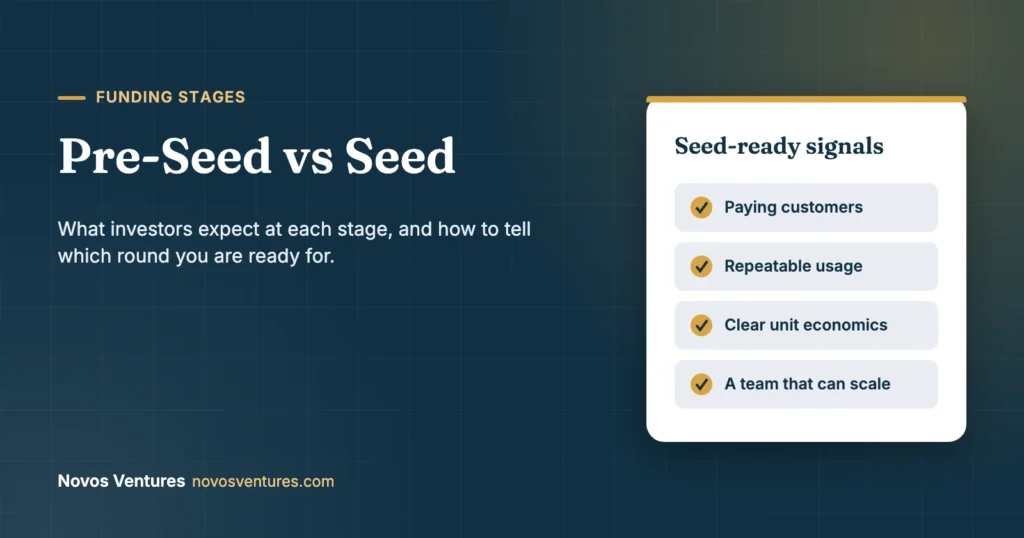
Pre-seed funding typically helps founders test whether a real customer problem can become a business. Seed funding typically helps a team build on early evidence of demand and work towards a repeatable way to win customers. The boundaries vary by sector and investor. The practical question is what you can show today and what the next round will help you prove.
Start by identifying the milestone you need to reach. At pre-seed, that could mean validating demand through customer interviews or a pilot. At seed, it could mean showing that customers keep using the product or that a sales channel can bring in customers consistently.
| Stage | What investors look for | Example milestone |
|---|---|---|
| Pre-seed | A clear customer problem and early evidence that the team can solve it. | Run a pilot and test whether customers will pay. |
| Seed | Evidence of demand, retention and a plausible way to win more customers. | Show that multiple customers renew and that one sales channel can reliably generate qualified leads. |
If you need help turning those milestones into a pitch and financial plan, explore Novos Ventures’ Investor Readiness services.
Why the label matters
Investors organise themselves by stage. A fund’s mandate, cheque size and portfolio model are built around a particular point in a company’s life, and partners screen deals quickly against it. If your deck says “seed” but your traction says “pre-seed”, the mismatch is often enough for a polite pass, even when the business itself is interesting.
Getting the stage right helps you:
- Target the right investors, rather than spending months on funds that never write cheques at your stage.
- Set a credible raise amount, tied to the milestones the money will buy.
- Frame your evidence so it answers the questions that investors at that stage are actually asking.
What pre-seed usually means
Pre-seed is money to prove that a problem is real and that your team can solve it. Many companies at this stage have a prototype or an early product, a handful of pilot users or design partners, and a lot of conviction built from customer conversations.
At pre-seed, investors are mainly betting on:
- The team. Why are you the right people for this problem? Relevant experience, insight that others lack, and evidence that you can ship and sell matter more than anything on a spreadsheet.
- The problem. Is the pain sharp, frequent and costly enough that customers will pay to fix it?
- Early signals. Letters of intent, waiting lists, pilot feedback, a prototype people use without being chased. Small, but real.
- The plan. A clear view of what the money buys and which milestones will make the company fundable at seed.
Pre-seed rounds are often raised on convertible instruments such as SAFEs, ASAs or convertible loan notes, because pricing a company with little data is hard. If you are weighing these up, our guide to SAFEs, ASAs and priced rounds in Ireland and the UK explains the trade-offs.
What seed usually means
Seed money is for turning early proof into a repeatable business. By this point investors expect you to have moved beyond “people say they want this” to “people are using it and paying for it, and we are starting to understand why”.
Seed investors typically look for:
- Product-market fit signals. Paying customers, usage that holds up over time, and retention or repeat purchase that suggests the product is genuinely valued.
- A first view of the economics. Early numbers for what it costs to win a customer and what that customer is worth, even if the data is thin.
- A go-to-market hypothesis. Which channels have worked so far, and how the round will help you test and scale them.
- A stronger team. Founders plus the first key hires, or a clear plan for who you will hire and why.
- A financial model. Not a precise forecast, but a reasoned plan that links spending to milestones and shows how long the money lasts.
Seed rounds are more often priced, with a lead investor setting terms, although convertible instruments remain common in smaller rounds. Expect more structured due diligence than at pre-seed: cap table, contracts, IP ownership, company records and the numbers behind your claims.
Who invests at each stage
The investor mix shifts as a company matures.
- Pre-seed: founders’ own networks, angel investors and angel syndicates, accelerators, pre-seed specialist funds and, in Ireland and the UK, a range of public and regional support schemes. Angels with sector experience can be especially valuable because they bring introductions and judgement as well as money.
- Seed: seed-stage venture capital funds, larger angel syndicates, some family offices and, occasionally, corporate investors. A seed round usually needs a lead who sets the terms and does most of the diligence, with others following.
Whatever the stage, research investors before you contact them. Check their stated stage, sector focus, typical cheque size and recent deals. A targeted list of investors who genuinely fit will outperform a long list of names every time; our investor database is built to help with exactly that.
How to tell which round you are ready for
Ask yourself these questions and answer them as an investor would, not as a hopeful founder:
- Do customers pay today? If not, or only as heavily discounted pilots, you are most likely raising pre-seed.
- Is usage or revenue repeatable? One large customer won through a personal connection is encouraging, but it is not yet a repeatable process.
- Do you know your numbers? If you can explain how customers find you, what it costs to acquire them and why they stay, you are moving into seed territory.
- Is the team in place to execute the next stage? Seed investors want to see who will build, sell and run the business as it grows.
- Can you show what the money buys? Both stages need this, but at seed the milestones should be measurable commercial ones, not just product releases.
If your answers are mixed, that is normal. Many founders raise a “pre-seed plus” or a small bridging round to reach clearer seed milestones. That can be the right decision, provided you are open with investors about what the round is for. Our Investor Readiness Checklist is a useful way to spot the gaps before you start.
Common mistakes at each stage
At pre-seed:
- Raising too little to reach a meaningful milestone, so you are back fundraising before you have anything new to show.
- Giving away too much equity too early, which can make the cap table unattractive to later investors.
- Over-building the product before talking to enough customers.
- Agreeing terms on convertible instruments without modelling how they will convert.
At seed:
- Presenting vanity metrics, such as sign-ups or page views, instead of evidence of retention and revenue.
- Leaving the data room until an investor asks for it, which slows diligence and weakens your position.
- A pitch deck that still tells a pre-seed story about vision and team, without the commercial proof seed investors are looking for.
- Approaching too many investors at once without a clear lead strategy.
Getting from pre-seed to seed
The best time to plan your seed round is when you close your pre-seed. Agree internally what “seed-ready” means for your company: a set of commercial and product milestones that would make the next raise straightforward. Then build your plan, hiring and spending around reaching them with time to spare.
Along the way, keep investors informed. Short, regular updates to existing backers and to investors you hope to bring in at seed build trust and make the eventual conversation much easier. Keep your financial model, cap table and key documents up to date, so that when you are ready to raise you can move quickly.
How Novos Ventures can help
Working out which round you are ready for, and closing the gaps, is at the heart of our investor readiness services. The Investor Ready Program takes you through your pitch, financial model, valuation and diligence preparation, and our fundraising support helps you reach the right angels, VCs and family offices across Ireland, the UK and Europe.
If you would like an honest view of where your company sits today, book a call with our team.
Model your next round
Open the full calculator, worked examples and FAQ
Funding news and practical founder guides. Free.
Illustrative only. Not financial or legal advice. Nothing you enter leaves your browser.